Paint Colors - Two Branches Series
Emma Chose the Blue Paint

In Volume 3, July 4 of The Unselected Journals of Emma M. Lion by Beth Brower, we believe something significant happened that could be interpreted as a Giant Easter Egg. It’s potentially so giant that it is possible the author has given us The Answer to the series of which man Emma will pick as her final love, even though it’s only Volume 3! Obviously a LOT is still to come, so we must take such ideas and interpretations with a grain of salt, an open mind and a willingness to examine other options as the story unfolds. But, we still think this moment deserves an honored place in our posts and this is why it is our first post in the series of Two Branches. It should be examined closely.
This post is part of the support for our ongoing analysis in our series looking at who are the Two Branches, please find our introductory post here.
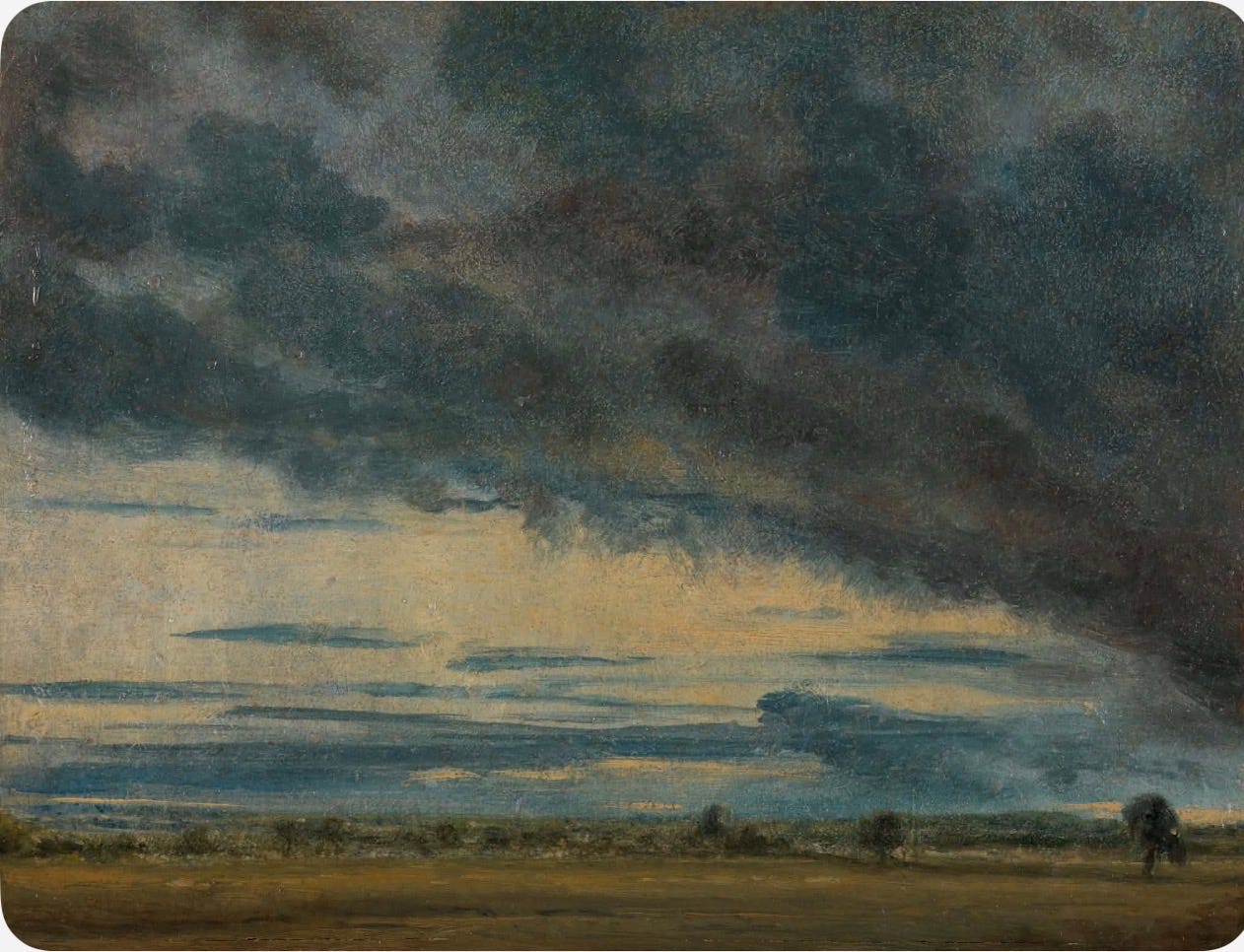
Image: “Cloud Study” by John Constable, 1776-1837. We like the blues and greys in this sky
Background: Pierce has just asked to let the salon to be his portrait studio. On July 4, he and Chambers are remodeling it by adding a door to access it through Lapis Lazuli Minor. Emma has gone for a walk and then heard a lot of clatter in the Salon, so she knocked on the door to enter. Pierce is standing with a paint brush in one hand, focused on two paint colors he painted on the wall: charcoal grey and midnight blue.
First, Emma is asked what she thinks of them. She responds by saying, “Beautiful. Both of them.” As we consider the meaning here, we have to first acknowledge that colors are highly symbolic in this series. The main characters are symbolized by the following colors: Emma=light green/seafoam green, Islington=dark green, Pierce=grey, Hawkes=blue. (Please see our post on our Intro to Color Symbolism.) Pierce has painted out two patches of colors: blue and grey on the wall. We think these colors therefore represent Hawkes and Pierce. When Emma says that both are beautiful, this is foreshadowing the upcoming fortune on May Day in Volume 8 where she has two loves, one deep and one complete.
Emma’s next line after, “Beautiful. Both of them” is the very telling: “The blue is especially lovely.” The word “lovely” is a very loaded word used a few times throughout the journals and seems to carry extra weight in Victorian terms. We see it in expressions of love and commitment in other books from this era (For example, as Mr. Rochester declares his love in Jane Eyre, he says, “I think you good, gifted, LOVELY…a solemn passion is conceived in my heart; it leans to you, draws you to my center and spring of life, wraps my existence about you, and, kindling in pure, powerful flame, fuses you and me in one.” Jane Eyre, Chapter 27, by Charlotte Brontë, emphasis added.) So we think the word “lovely” carries more weight in Emma’s era than it does now. Emma and Hawkes have both used it to describe each other. Emma says, “Hawkes, you are lovely” after she catches the errant pear-scented letter at Jacob’s Well. And Hawkes says the Roman called Emma “lovely” when he asked that she stop tracking him. Emma found this so flattering that she repeated it several times and it has even made it into the Roman’s description in the “persons of interest” at the beginning of each book: “The Roman-Still not seen in person. However, he thinks I’m lovely.” (Aside: was this the actual way the Roman said it, or does it reflect that Hawkes wanted to say it in an indirect way?) We also see this word in the description of Hawkes’ face (Vol 8 May 21) when Emma is in his room: “His eyes were a complicated blue, the articulation of his face masculine, quiet, LOVELY.” (Emphasis added.) So, back to paint colors, Emma thinks the blue is “especially lovely,” and lovely is used to describe both Hawkes and Emma with significant meaning. It seems to layer additional depths to the color choice. It does not seem to be an adjective used to describe Islington or Pierce throughout the series.
Emma then gives the two paint colors considerable attention. She likes both. She doesn’t want to decide and suggests flipping a coin. This is significant that if her two branches (or two loves) are Pierce and Hawkes, they will be both be dear to her and she won’t want to have to decide. We think this foreshadows what will be coming up in later volumes - that it will be difficult to decide between Pierce and Hawkes. She won’t want to. Pierce does not agree with flipping a coin, in symbolism of what is to come. He knows that is not the right way to select something (maybe a small decision here for paint colors, but would be untenable when deciding who to marry) and he says he never “gambles his decisions.” Emma sees this in an interesting light: “Whyever not?… Either way the coin falls, you will be pleased with the colour.” This again reflects the prophesy - that both loves are true and happiness can be found with either branch of the tree, though different types of happiness.
We would be remiss if we did not acknowledge that the color green (Islington’s color,) was also brought up and questioned by Pierce in this scene, after Emma declares that the dark blue and grey colors both have a “Mr. Rochester” vibe to them. (Note: saying that blue is “Rochester” might potentially throw the reader off the scent of Hawkes a little, however, it cannot be denied that blue=Hawkes, no matter what shade, even dark or midnight blue.) Pierce then questioned what green would be, and Emma then speaks of leaving the Brontë’s moodiness and entering into “Austen territory.” This seems to either allude to or foreshadow Islington as being modeled on “Pride and Prejudice” or “Emma” or another Jane Austen character. However, green is not considered at all among the actual options presented to Emma in this scene (and consequently we believe that Islington is not one of the two choices for Emma to consider as a true romantic love option in the symbolism of this moment). However, we acknowledge that there is a long timeline to these books and things being planted early on do not always surface until later. One could certainly make an argument that Pierce thought that the green “Austen” color would represent a “better” choice than the moody “Mr. Rochester” colors being discussed. This theme is echoed further after Islington falls ill in Volume 7 and the idea of Islington in Emma’s arms made Pierce jealous. Pierce acknowledged at that time that Islington would certainly be a more admirable/respectable match for Emma than himself, echoing what is being said here in the salon. Back to our scene in July, though, Emma wasn’t convinced that an Austen man meant a “better man” - she thought it depended on whether the man in question was the hero, the villain, or the fool… and the idea of green for consideration as a paint color option is dropped after this.
Later that evening, as notes were passed through the wall, Emma asked Pierce if he had picked a color between blue and grey and he had still not picked. This is notable because we think it means that, symbolically, Pierce recognizes that he should not be solely responsible for making the selection, it is Emma’s decision too.
After some discussion about other colors in the room (the red drapes and plum sofa), Emma brings her father’s opinion into the decision matrix. He was an artist, and was outspoken on his opinions regarding colors. The RHSS wants to bring attention to this because even though they are talking about paint, we believe this entire choice could be a metaphor for Emma’s life. Even posthumously, the hand of her father is still influencing and guiding certain elements of Emma’s life. As such, Declan presumably would have had fierce opinions about any man wanting to court or marry her (despite his simultaneous feelings that she should also be free to choose that man for herself). Therefore, the symbolism in this wall paint choice combined with Beth Brower’s paid substack essay, “For Now” is telling us that Declan would place great importance on getting “the colors” right and the consequence of this decision weighs on Emma. Since we also know the colors in this series represent characters, we think we can reasonably justify this parallel. So if Declan’s opinion is considered, what choice should Emma make? Pierce has noted before that he believes Emma’s parents would not approve of him as a partner for Emma. On the other hand, Declan trusted Hawkes so much he gave him the means to legally become her guardian after she turned 21, even though Hawkes was only 20 or 21 at the time himself. Now, back to the paint choices. As she considers the options from this new perspective (remembering her father’s opinions), she feels more confident and easily decides the color. “I think you should choose the blue.” Similarly, we wonder, will her consideration of her parent’s opinions play a role in the decision on who she eventually marries? We think so.
One special note: once Emma declares her choice, Pierce does not hesitate or argue, he agrees quickly. Then he states he will use the grey in his own personal space, the West Garret. We believe this shows great promise for purposes of our foreshadowing metaphor, that Pierce would be able to tolerate Emma’s potential selection of Hawkes in the future. We are also hopeful this means that Pierce will be able to accept Emma’s romantic choices (even if it is not him), thereby preserving the Alchemy friendship. He would withdraw his Pierce-grey sharpness and keep it reserved for his separate/private life, allowing the shared overlapping spaces of their lives to be for Emma and her Blue-Hawkes.
This is a small detail presented so early in the series, but fascinating to consider retrospectively with the benefits of all our knowledge from subsequent volumes. Emma chose blue paint. We think it could very well indicate that she will choose Hawkes.
This is amazing! I too found that the conversation had more meaning than just choosing a color for painting the wall. I don’t know if you agree but when you re-read this series and understand Beth’s writing style it’s obvious there are scenes that, although could be trivial, make readers have the sense that there is much underneath them and could be potential easter eggs.
Really really amazing theory and analysis! 🫶🏻
I was just listening to Book 3 again and thought about this, but dismissed it when she calls the blue a Rochester color. Love this!